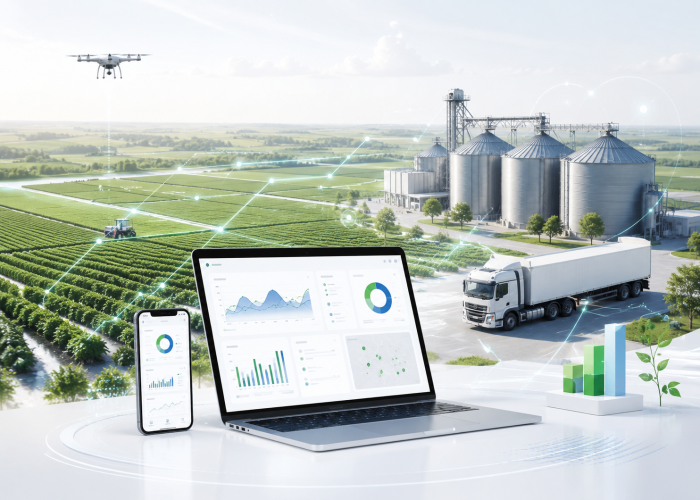
5 signs that your agricultural business is ready for digital transformation
Why digital transformation is important for agribusiness
The digital transformation of an agribusiness begins with a specific business need: to access data more quickly, manage processes more effectively, reduce manual work and make fact-based decisions.
This is particularly important for agribusiness. Fields, grain silos, logistics, documentation, machinery, landlords, finances and the team all operate as a single chain. When one stage slows down, it affects the entire operational process.
Automation in agribusiness helps make operations more transparent, faster and more manageable. But how can you tell if your company is ready for digitalisation?
Below are 5 signs of readiness for digital transformation and 3 signals that it’s time to take action.
5 signs that your agribusiness is ready for digital transformation
1. The data is already there, but it’s scattered across various sources
Your company may have spreadsheets, reports, messaging apps, paper documents, individual files and internal systems. Information accumulates every day, but you have to piece together the full picture of your processes manually.
For example, an agronomist keeps records in one format, a logistics specialist checks the status of deliveries by phone, the accounts department waits for documents, and the manager only receives the final figures once the work is complete.
This is one of the first signs of readiness for digitalisation. The company is already working with data, but needs a unified approach to its collection, processing and use.
What helps:
An ERP system, digital records, a unified database, mobile apps for field teams, and electronic document management.
2. Managers need an up-to-date overview of processes
Management decisions in agribusiness often depend on speed. It is important to understand what work has been carried out in the field, where vehicles are located, the status of waybills, whether a shift handover has been completed, what is happening at the grain elevator, and which tasks have already been completed.
When the team has to gather answers to these questions through phone calls, messages and manual reports, the company wastes time.
Digital solutions for agribusinesses enable you to view the status of processes in near real time and respond more quickly to changes.
What helps:
dashboards, task statuses, ERP integration, and mobile solutions for agronomists, logistics specialists, drivers and division managers.
3. Manual coordination takes up too much time
Phone calls, clarifications, file transfers, coordination via chat groups, and manual data entry often become a routine part of day-to-day operations. But when there are too many of these tasks, the team spends time on coordination rather than managing the process.
Automating agricultural processes helps to integrate routine scenarios into the system:
- completing work completion reports;
- handing over vehicles between drivers;
- booking slots at the grain elevator;
- signing e-waybills;
- task management;
- processing requests;
- interacting with staff and landlords.
The more repetitive tasks a company has, the greater the value delivered by digitalisation.
4. The team is already ready to work with digital tools
Readiness for digital transformation also means that people are ready. If staff are already using mobile apps, chatbots, electronic documents, dashboards or internal systems, the roll-out of new solutions goes much more smoothly.
For agribusiness, it is important that a digital tool is convenient to use in the field, on the road, at the grain elevator, in the office and in the accounts department. Therefore, modern AgTech solutions must take real-world work scenarios into account:
- quick access via a smartphone;
- clear steps for the user;
- clear status indicators;
- synchronisation with accounting systems;
- recording of activity history.
It is precisely this approach that helps teams integrate digital tools into their daily work more quickly.
5. The company is planning to scale up
If an agricultural company is expanding its land bank, increasing its fleet of machinery, or working with a greater number of grain silos, partners, landlords or customers, manual processes quickly become a bottleneck.
On a small scale, many tasks can be managed using spreadsheets, phone calls and personal oversight. But as the business grows, a system is needed to ensure process stability.
Digital transformation helps agribusinesses scale up through:
- standardised operating procedures;
- transparent statuses;
- a shared database;
- performance monitoring;
- real-time analytics;
- integration across departments.
This provides the company with a foundation for growth without chaos in its operational processes.
3 signs that it’s time to take action
1. Decisions are made after the problem has arisen
If a manager only spots a discrepancy after work has been completed, a journey has been finalised or a report has been generated, the company reacts too late.
During peak season, even a few hours can make a difference. It is therefore vital that data is entered into the system on time and that those responsible can see the current status of processes.
This applies to agronomy, logistics, grain elevator queues, e-waybills, CRM, ERP and other areas where the speed of information directly affects the outcome.
2. The team spends a lot of time searching for information
If staff are constantly asking where a document is, what the status of a flight is, who has approved a task, what’s the situation with the vehicle, when the slot at the grain elevator is, or where the latest version of the data is — the process needs to be systematised.
Finding information should take just a few minutes. When everyone works within a single digital ecosystem, data is available to those who need it for their work.
This speeds up interaction between departments and helps reduce the operational workload.
3. Errors recur due to human error
Manual data transfer, duplication of information, different file versions, missed approvals and inaccurate statuses create risks for the business.
Automation helps to reduce the number of such situations. The system guides the user step by step, records data, maintains a history of actions, forwards information to the relevant modules and helps to monitor progress.
For an agricultural company, this means greater transparency, less wasted time and better-quality management decisions.
Where to start with the digital transformation of an agricultural company
The digitalisation of an agricultural company should begin with the process that creates the greatest workload or most frequently affects operational speed.
For some companies, this is agronomic planning and work completion reports. For others, it is logistics, electronic queuing at grain elevators, e-waybills, CRM, ERP or internal services for staff and partners.
AP Digitals is developing an ecosystem of digital solutions for agribusiness, covering the key areas of an agribusiness’s operations.
AP Digitals’ digital solutions for agribusiness
AP ERP — a solution for business process management, accounting and a unified data system. It helps companies manage their processes within a single digital environment and lay the foundations for management analytics.
AP Agronomist — a digital tool for agronomists in the field. It helps them work with field maps, work completion reports, operation histories and synchronisation with the ERP.
AP Logistics — a solution for managing the vehicle fleet, shift rotations, maintenance, repairs and reports. It helps to streamline the interaction between drivers, mechanics and the accounting system.
AP Elevator Queue — an electronic queue system for grain elevators. The solution helps to organise grain intake and dispatch, slot bookings and transparent management of transport flows.
e-TTN from AP Group — a digital solution for creating, editing, tracking the status of, and signing consignment notes.
AP Checkman — a tool for checklists, task management and recording completion during the work process. It helps to standardise operational checks and monitor the status of tasks.
AP Assistant — a chatbot for common internal enquiries from staff. It helps to get answers faster and reduces the workload on the relevant departments.
AP Landlord Assistant — a chatbot for interacting with landlords. It helps streamline routine enquiries and makes communication more convenient and faster.
Readiness for digital transformation is the point at which a company already has the processes, data and team in place, but needs greater speed, transparency and manageability.
The agribusiness sector operates in a fast-paced, seasonal environment with a large number of interlinked operations. This is precisely why digital solutions are becoming a practical tool for day-to-day work: from the field to the grain elevator, from a transport journey to a document, from a request to a management decision.
If your agribusiness has accumulated manual processes, fragmented data and a need for better control, AP Digitals will help you find a digital solution tailored to your needs.
Find out more about AP Digitals’ solutions on the website:
ap-digitals.com
Read also

From the land bank to precise field boundaries: how AP Digitals is digitising land management
AP Digitals is developing digital solutions for land management and field operations